Waterford Driving Test Routes – What to Expect, Common Mistakes & Local Tips
If you're searching for Waterford driving test routes, you're probably trying to figure out where the examiner will bring you, what junctions catch people out, and how to avoid silly fails. This page is built specifically to help learner drivers prepare for the Waterford RSA driving test centre, using real-world route patterns and local problem areas — not generic advice.
Unlike vague blog posts, this page focuses on how the Waterford test actually feels, what learners commonly fail on, and how to practise properly using mapped routes.
Updated July 2026 based on learner feedback and local route observations.
About the Waterford Driving Test Centre
The Waterford driving test centre serves learners from Waterford city and surrounding areas. Tests usually involve a mix of:
- Residential estates
- Busy town-centre junctions
- Roundabouts
- National / regional roads
- Speed-limit transitions
- Tight turns and observation-heavy areas
The routes tend to loop back toward the test centre, meaning you'll often re-enter familiar roads from different directions.
How Waterford Driving Test Routes Usually Work
There is no single fixed route, but examiners reuse the same road clusters again and again. If you practise enough of these, nothing on test day feels new.
Typical features of Waterford test routes include:
- Residential estates with poor visibility
- Multi-lane roundabouts
- 50 → 60 → 80 km/h transitions
- Narrow roads requiring strong positioning
- Junctions where hesitation causes faults
- Areas where observation matters more than speed
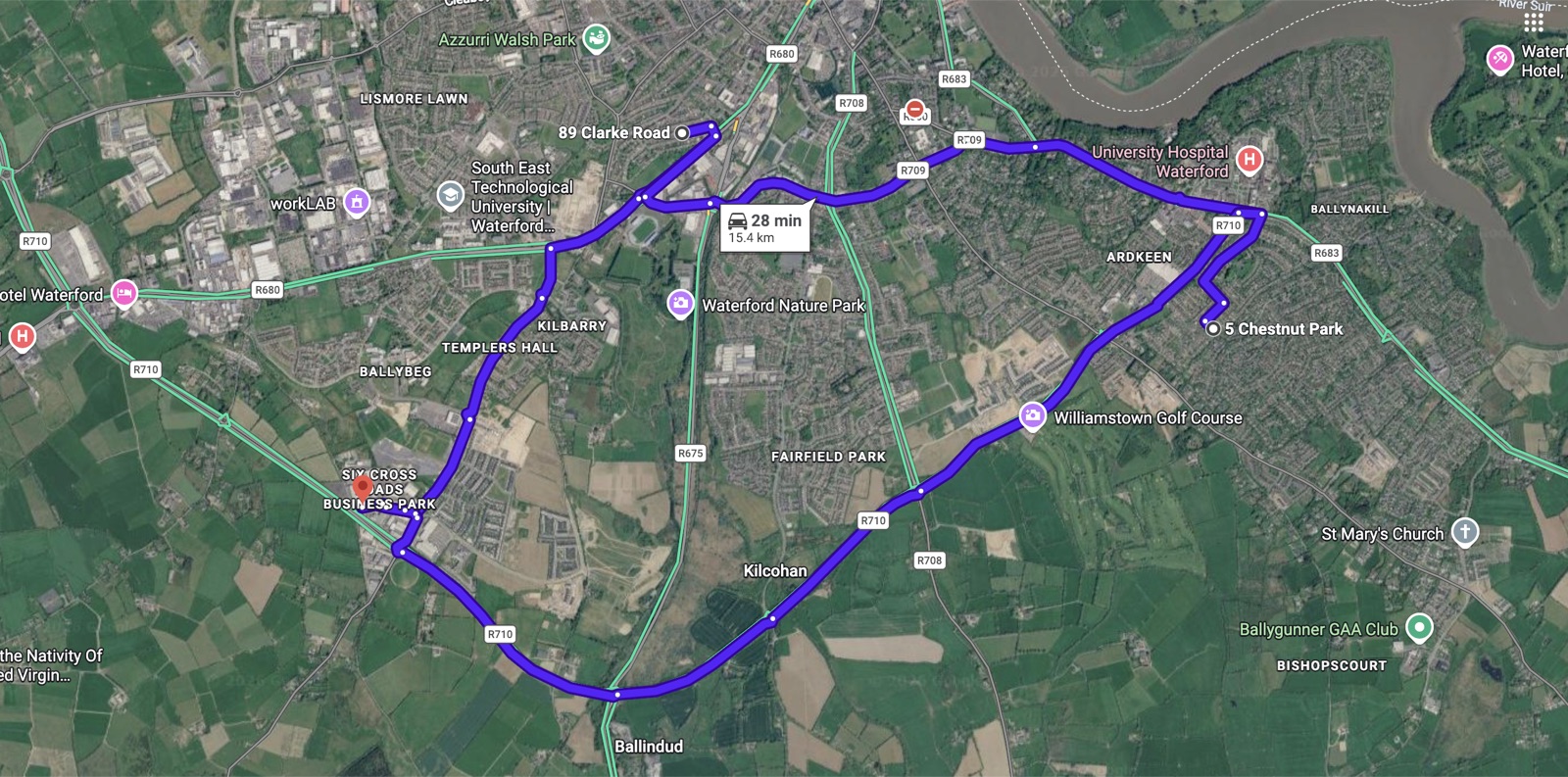
This is why using Google Maps–based practice routes is effective — you learn geography, not memorised instructions.
Common Areas Used in Waterford Driving Test Routes
While routes vary, learners are often brought through or near:
- Town-centre approaches and main approach roads
- Residential estates near the test centre
- Main distributor roads with changing speeds
- Local school zones and pedestrian areas
- Roundabouts linking estates and main roads
- Roads connecting nearby suburbs
You don't need to memorise one exact path — you need familiarity with patterns.
Roundabouts Commonly Used in Waterford Tests
Roundabouts are one of the biggest fail points in Waterford.
Multi-lane roundabouts
These test:
- Lane discipline
- Early lane choice
- Proper signalling
- Mirror checks before changing lanes
Mistakes here often come from:
- Drifting lanes
- Late signalling
- Cutting across exits
- Hesitating unnecessarily
Smaller residential roundabouts
These test:
- Observation
- Yielding correctly
- Smooth approach speed
Many learners slow too much or stop when they don't need to.
Junction Types That Catch People Out
1. Hidden / offset T-junctions
These appear simple but have poor visibility. Examiners watch for:
- Full stop when needed
- Proper creep-and-peep
- Looking both ways, not just right
2. Wide junctions with fast traffic
These test judgment, not confidence. Pulling out too slowly = fault. Pulling out unsafely = fail.
3. Junctions after bends
You must position early and slow in advance — late braking is a common issue.
Speed Limit Traps in Waterford
Speed awareness is one of the biggest reasons learners fail.
Common problem areas:
- Roads that look like 80 km/h but are actually 50 km/h
- Transition zones where the sign appears late
- Residential areas that feel "wide" but are still 50
- Areas where limits drop suddenly near estates or schools
Examiners expect you to:
- Actively scan for signs
- Adjust speed quickly
- Not rely on road width
Missing a speed change is an instant mark.
Common Mistakes Learners Make in the Waterford Test
These come up repeatedly:
- Poor mirror checks before signalling
- Late or missing indicators
- Hesitation at junctions
- Rolling stops
- Drifting wide on left turns
- Poor lane discipline at roundabouts
- Not checking blind spots
- Overconfidence on familiar roads
- Underconfidence at busy junctions
Most failures aren't dangerous — they're accumulated small errors.
Local Examiner Behaviour (What People Notice)
While examiners follow RSA rules, learners often notice patterns:
- They like smooth, predictable driving
- They dislike hesitation more than calm commitment
- They watch observation closely at junctions
- They notice mirror–signal order
- They expect confident speed control
You're not being "tricked" — you're being watched for consistency.
Areas Where Learners Commonly Fail
Based on repeated feedback:
- Roundabouts near main distributor roads
- Estate exits with poor visibility
- Speed-limit transitions
- Busy junctions during peak hours
- Tight left turns near kerbs
- Pulling out too slowly
Practising these areas repeatedly makes a massive difference.
FAQs – Waterford Driving Test
How long is the Waterford driving test?
Usually 40–45 minutes including questions and manoeuvres.
Are the routes fixed?
No. There are multiple Waterford driving test routes, but they reuse the same roads.
Can I practise the exact routes?
You can practise realistic practice routes that reflect how tests are structured, even if the exact path changes.
Is Waterford considered a hard test centre?
It's average — not easy, not brutal. Most failures come from observation and hesitation, not "tricky roads".
What's the best way to prepare?
Drive the area repeatedly, understand junction behaviour, and practise roundabouts under light and heavy traffic.